
Education
Role of Government

For two hundred years, the excellent education system of the United States was a key factor in the success of our nation.
Our current education is a disgrace and a monumental waste of money.
Most of my readers should realize that I favor a dramatically smaller government (like a national government that is one fifth the size of our current government (aka about 20% of it’s current size). But I don’t favor completely abolishing government.
Government, in my opinion, can play some valuable roles:
Military defence (until humanity can gain enough sanity and wisdom to stop killing each other)
Funding “common good” projects (note: this should be extremely minimal and simple)
Establish and maintain a stable currency (which we have completely failed at since Nixon eliminated the last remnants of the gold standard)
Provide a justice system to provide “law and order”
Overall government’s role is to protect the individual rights of the citizens.
Beyond this fundamental role, government can help advance the common good of the citizenry. One aspect of that is education.
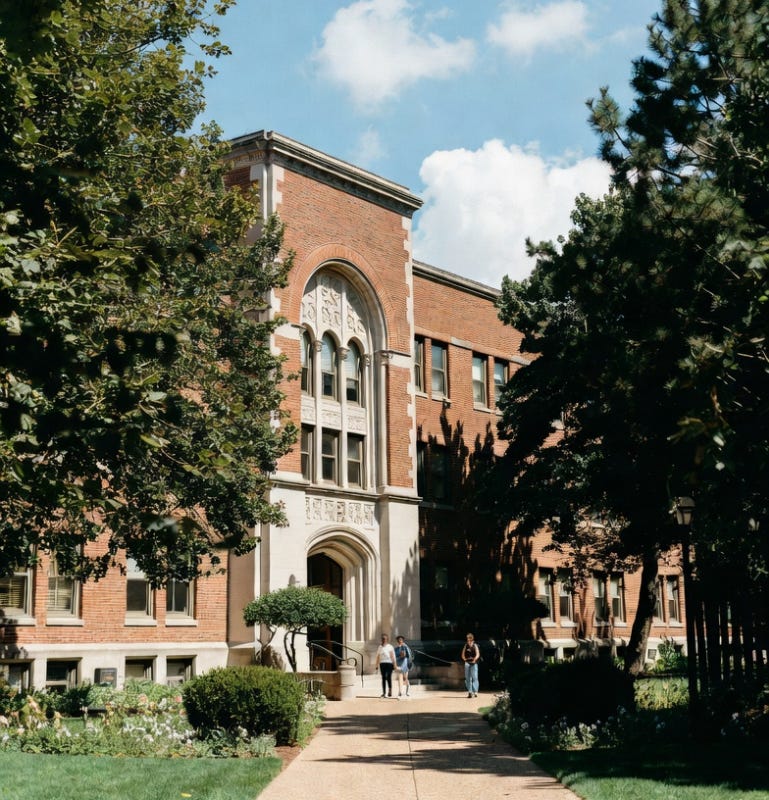
World War II demonstrated very clearly the value of education. World War II demonstrated that the level of education of a population, directly related to their effectiveness in combat. Germany with it’s excellent education was a brilliant example of this. Late in the war, the USA was able to field a competent, yet inexperienced, military largely because of skilled and well educated citizens.
Over the span of time (USA), colleges became more and more expensive, with more and more government support. Now, public universities get 70% of their funding from state aid. Still, a significant amount of funding is tuition and investments (universities have grown their wealth very well).
Attending college should not be expected of anyone desiring a good life. Certainly useless degrees should be far less common! College students should be there because they are serious about advanced study in a particular field, not because it’s what is expected of them.
As I see it, a problem is that college / university research is largely funded for profitable research rather than an emphasis on basic research. This should be reversed.
Certainly I believe in funding education for the common good, but currently the federal government provides over $250 billion dollars to colleges and universities. Let’s cut that back to something more like $50 billion (and even that might be too much). Imagine having your federal tax reduced by over $1,500 by just reducing how much is spent on colleges and universities!
Let’s emphasize basic research: chemistry, engineering, physics, and nutrition.
I’d like to hope that corporations and wealthy people would provide increased funding for education.
Thanks for the commentary.
A few thoughts come to mind.
In Bret Baier's book about the Eisenhower presidency, he said that Eisenhower considered several other additions to the "military/industrial complex." One of those additions would have read "military/industrial/academic complex." He recognized that just as some defense contractors were manipulating the system to add defense spending that wasn't necessary, academia was manipulating the system in the same way. That's a big problem for our nation.
Ideally, companies would fund more applied research on their own. I agree with you that government has a place in funding some basic research. Companies that fund applied research would have the first opportunity to apply for patents on those findings even if the research was published before the company was fully ready to apply for a patent. That safeguard would make funding research safer for the companies who provided those funds.
Part of the problem with funding research is that companies are spending so much money on other things. Today's corporation has to spend much more on legal departments than companies had to spend a hundred or a hundred and fifty years ago. The money that goes to paying lawyers to protect these deep pockets is money that doesn't go into helping the communities where the companies operate or funding research into topics that would help the companies.
One of the huge problems in our society is the most powerful labor union in the world. By that, I mean the American Bar Association. This lawyers' union has put itself into every position of power in this country and ensures that its members always have jobs. No matter which way any policy initiative goes, the employment opportunities for lawyers increases. Our society keeps putting more and more of our production into lawyers arguing with one another instead of investing in people making things. That trend is not sustainable.
I've long believed that another change that we need to make in education is to eliminate most of the PhD programs and many of the Master's degree programs in education. The purpose of a PhD thesis is to advance the theory of a particular field. The purpose of a bachelor's degree is to teach students the theory and some basics of application. A master's degree is somewhere in the middle. We don't need more education theory. We need excellence in application at the primary and secondary levels.
There are other fields where we don't need more theory. If universities still want to have those programs, they should feel free to offer them, but the government shouldn't be spending money to keep all of those PhD programs operating. I can see where some English departments might not have PhD candidates in the program at some times. That's okay. The regular professors can keep teaching undergraduates and advising graduate students only as necessary.
In other fields, maybe we need to eliminate the bachelor's programs. My best friend who died recently was a political science professor. His bachelor's degree was in political science, Spanish, and religion. I always joked that he was qualified to take over a Central American country. Even though he loved his work, he believed that a bachelor's degree in political science was not valuable. I think his argument was that political science should be rolled into history or sociology programs. This would reduce the administrative overhead at universities. The same classes could still be taught, but they would be under other departments to reduce the number of departments being funded. He wrote a paper with a title something like "Do You Want Fries With That? - An exploration of the value of the bachelor's degree in political science."
For many of the hard sciences, the master's and PhD programs have more value even with paid teaching and research assistants. In my fields, people who would have been worth thirty to fifty thousand dollars per year would be scraping by on six to eight thousand dollars a year while spending sixty or seventy hours a week on classwork and research. The research we did could not have been done for less money. We were contributing to the advancement of science and engineering and we were expanding our education in ways that would make us more valuable when we went into industry after finishing our degrees.
Many of the softer sciences and humanities could be funded by private industry in those areas. Grad students in the English department don't need the lab facilities that engineering students do. They need good libraries that the universities should have anyway. With electronic communication advancing, what the need for research can be scanned and shared across libraries in PDF documents instead of anyone having to pay for bound books. Our entertainment industry makes huge amounts of money, and that industry could fund performing arts programs, English programs, and music programs. Government shouldn't abandon those areas completely, but government doesn't need to spend a huge amount of money to protect our rights by funding Romeo and Juliet.
Much of the problem is that so many of the sciences are caught up in the funding game by playing politics. If they publish papers saying that global warming is going to cook the entire planet in twenty years, panicked citizens will call their representatives to ask for more money to be spent to study global warming. If they present a more balanced view that climactic changes are slow and largely beyond our control and that nothing catastrophic is likely to happen in our lifetimes, those same citizens will go back to watching American Idol and not care whether the Climatology Department gets another fifty million dollars next year. In that scenario, the "climate scientists" are going to be "climate used car salesmen" for their departments. They'd rather have the prestige of being university professors than trying to be weathermen (and women) at the local TV station.
Part of the problem now is that an entire generation or two of teachers has been caught up in the system. The teachers that I had who tried to teach subjects seriously when I was in primary and secondary school are gone. Instead, they've been replaced by teachers who are just playing propaganda games and trying to make people happy. Some of them really are unfair and abusive towards their students. I understand good parents not wanting to give them more power. On the other hand, the lack of power means that good teachers can't maintain discipline and teach good students in vigorous academics. The effect is that finishing elementary school doesn't mean what it once did. A high school diploma doesn't mean what it once did. Because our primary and secondary schools have been cheapened, our high school graduates are not the high quality graduates that we once produced.
The loss of quality in high school graduates means that the quality of college educations has dropped. That's not to say that everything is doomed. Before my health failed, I worked with many young engineers, and many of them were very good. On the other hand, my best friend constantly talked about the problems that he had trying to make his students understand anything or put forth any effort.
In many ways, I think the problem started with what they call "The Greatest Generation." I realize that those people did great things to bring our nation through the horrors of the period that includes both world wars. They were also instrumental in bringing about the downfall of the Soviet Union and that particular horror of communism. The problem is that in their desire to do better for their children, they didn't raise their children as well as they had been raised. Those Baby Boomers and even some pre-Boomers grew up spoiled and stupid. Many of them raised children that were worse, and the problems have followed with each generation. Problems in the education system are symptomatic of the overall problem.
I am encouraging my children to go into trade school. Do something with their hands and be useful. It might actually protect them from AI taking over their field.
I have the most useless degree in the world. I spent a lot of money in acquiring it and the biggest asset I walked away with wasn’t any particular skill I was taught, but the network of relationships I made with my peers. We still, to this day, help each other with gigs. The amount of times I’ve been asked to produce a diploma for the work I land is zero. And I work in my field!